Speed Balls
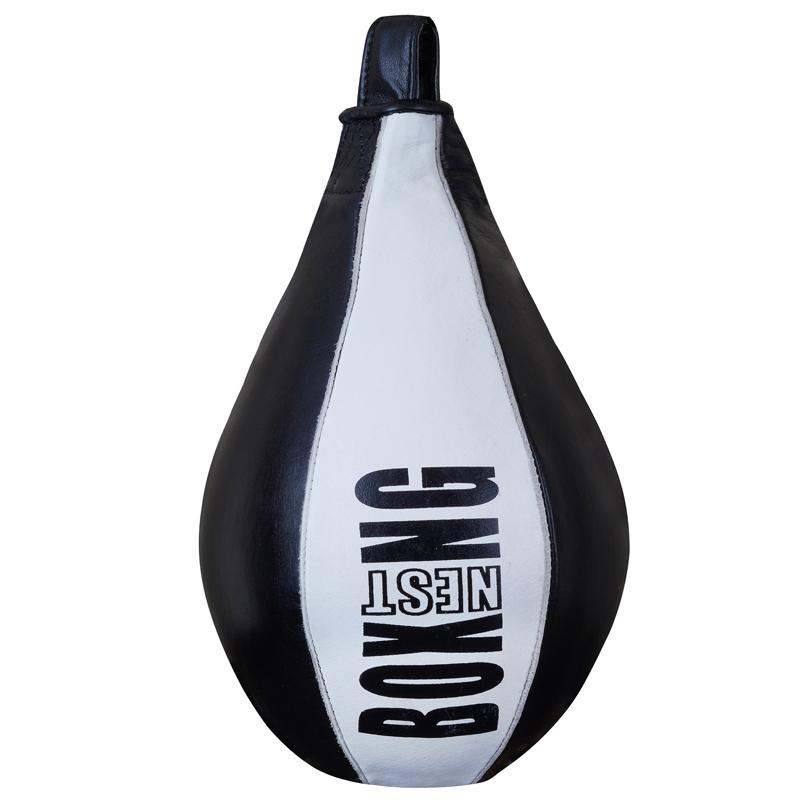
Product Specifications
| Specification | Details |
|---|---|
| Material | Genuine leather outer shell |
| Bladder | Durable rubber air bladder |
| Sizes | Small, Medium, Large |
| Swivel | 360° ball-bearing swivel (included) |
| Platform | Adjustable wooden/metal platform (optional) |
| Use Case | Hand speed, rhythm, timing, cardio |
| Origin | Sialkot, Pakistan |
Key Features
- Genuine leather construction for authentic feel and durability
- Smooth 360° swivel for fast, consistent rebound action
- High-quality rubber air bladder maintains pressure longer
- Multiple sizes for different training levels and hand sizes
- Develops hand speed, timing, rhythm and eye-hand coordination
- Compatible with standard speed ball platforms
- Adjustable platform height for all user heights (when included)
Speed Ball Size Guide
| Size | Dimensions | Best For |
|---|---|---|
| Small | ~20 × 15 cm | Advanced fighters, fast rhythm work |
| Medium | ~25 × 18 cm | Intermediate — most popular size |
| Large | ~30 × 22 cm | Beginners, slower timing development |
About Our Speed Balls
The speed ball — also known as the speed bag — is one of the most iconic pieces of boxing equipment and one of the most technically demanding to use well. Unlike the heavy bag, which rewards power, the speed ball rewards precision, rhythm, and timing. It develops the hand speed, eye-hand coordination, and rhythmic striking ability that are visible markers of an experienced boxer. The rapid, consistent rebound of a properly inflated speed ball on a quality swivel creates a fast feedback loop that challenges the athlete's ability to maintain contact with a constantly moving target — training attributes that transfer directly to the speed and timing demands of sparring and competition.
The quality of a speed ball is determined primarily by three components: the leather shell, the rubber bladder, and the swivel. All three must perform in harmony for the ball to provide the consistent, fast rebound that makes speed ball training effective. A stiff or low-quality rubber bladder creates an unpredictable, dead rebound that breaks the rhythm the drill is intended to develop. A poorly constructed swivel that binds or wobbles at high speeds creates the same problem. Our speed balls use genuine leather shells for authentic feel and durability, high-quality rubber bladders that maintain consistent air pressure over extended use, and precision ball-bearing swivel mounts that provide smooth 360-degree rotation at the speeds generated by advanced training.
The leather shell of our speed balls is the same quality leather used across our boxing glove range — a material choice that ensures the ball surface handles repeated knuckle contact without developing surface cuts or delamination. Cheaper speed balls use thin synthetic leather that splits at seam lines under sustained high-speed use, particularly in hot or humid training environments where the material becomes more brittle. Our genuine leather shells resist this failure mode and maintain their structural integrity through high-volume daily use in commercial gym settings.
How Speed Ball Training Benefits Boxers
Hand Speed Development
The speed ball's most immediate training benefit is the development of hand speed. The ball's rapid rebound after each strike forces the athlete to quickly recover the hand position and deliver the next strike within a tight time window. As the athlete's skill level increases, the tempo increases and the rebound time window decreases, continuously challenging the upper limit of their hand speed. Professional boxers who maintain regular speed ball training consistently demonstrate faster hand speeds than those who neglect this component of their conditioning — the training transfer to actual striking speed is direct and measurable.
Rhythm and Timing
Speed ball training is essentially rhythmic training with boxing-specific movements. The consistent rebound pattern of the ball creates a metronomic rhythm that the athlete must match and maintain. This rhythmic training develops the timing sense that underlies combination punching — the ability to deliver multiple strikes in rapid succession while maintaining the precise inter-punch timing that makes combinations effective rather than merely fast. Boxers who train regularly on the speed ball develop a natural rhythm in their striking that is visible even in sparring and competition, where the ball is absent but its rhythmic training has been internalised.
Eye-Hand Coordination
Tracking a rapidly rebounding speed ball and timing strikes to intercept it at precisely the right point develops the visual tracking and motor coordination that is the foundation of all boxing skill. The speed ball moves in a consistent, predictable pattern — which makes it approachable for beginners — while remaining fast enough to challenge even advanced practitioners as the tempo increases. This combination of predictability and speed challenge makes it an ideal tool for progressive eye-hand coordination development across all skill levels.
Shoulder and Forearm Conditioning
Extended speed ball training builds shoulder endurance and forearm conditioning that are essential for maintaining punch output through long sparring sessions and fights. The sustained, rapid arm movement required to maintain consistent speed ball contact over 2–3 minute rounds develops the slow-twitch shoulder endurance fibres that support sustained output, complementing the explosive strength developed by heavy bag work. Most professional boxing training programmes incorporate speed ball rounds specifically for this conditioning benefit in addition to the skill development purpose.
Choosing the Right Speed Ball Size
Speed ball size selection depends on the athlete's skill level and the specific training objective. The general principle is that smaller balls rebound faster, are harder to track, and are more demanding — making them appropriate for advanced practitioners. Larger balls rebound more slowly, are easier to time, and are more appropriate for beginners and for specific rhythm-development drills even at advanced levels.
The size guide provided in our specifications table reflects general recommendations. Individual athletes may find that their personal preference deviates from these guidelines — some beginners prefer starting on a medium ball to avoid the discouragement of struggling with a large, slow ball, while some advanced practitioners prefer a medium ball for warm-up work before moving to a small ball for peak-speed training. There is no single correct approach; experiment with different sizes to find what works for your specific training goals.
The Speed Ball Platform
The platform is as important as the ball itself. A speed ball on a poorly constructed or incorrectly mounted platform will not provide consistent training regardless of the ball quality. Key platform considerations:
- Height adjustment: The platform must be adjustable to position the ball at the correct training height. The ball should be positioned so that the bottom of the ball is approximately at eye level when the athlete stands at training distance. Incorrect height produces awkward striking angles that create bad habits rather than developing correct technique.
- Rigidity: The platform must be rigid — any flex or wobble in the platform surface absorbs energy from the ball's rebound and introduces unpredictable variation in the rebound pattern. Commercial-grade platforms use hardwood or steel plate construction for this reason.
- Wall mounting: Most speed ball platforms are wall-mounted using a bracket that provides a stable, rigid connection to a structural wall surface. The mounting must be to a stud or structural element — not to drywall alone.
- Swivel quality: The swivel connects the ball to the platform and must rotate smoothly through 360 degrees at high speeds without binding. Ball-bearing swivels are significantly superior to bushing swivels for this application. All our speed balls include a quality ball-bearing swivel.
Who Uses Speed Balls?
- Boxers at all levels: The speed ball is a standard component of boxing training programmes from beginner to professional level. No boxing gym is complete without speed ball stations.
- Muay Thai and kickboxing athletes: While kicking arts focus training elsewhere, the speed ball is used for hand speed and timing development that supports the striking game in kickboxing and Muay Thai.
- Boxing fitness participants: Speed ball stations are popular additions to boxing fitness programmes and boutique fitness studios. The visual appeal of speed ball work makes it a signature element of boxing-inspired fitness aesthetics.
- General fitness athletes: The cardiovascular and coordination benefits of speed ball training attract non-combat-sports athletes who want coordination training with an exciting and visually impressive exercise modality.
- Gyms and fitness centres: Commercial gyms with boxing equipment areas typically include speed ball stations as a standard fixture. The space efficiency of speed ball stations — a small floor footprint for a full training station — makes them practical for commercial gym layouts.
Care & Maintenance
- Check air pressure regularly: The rubber bladder requires correct inflation to provide consistent rebound. Under-inflated balls feel dead and slow; over-inflated balls are hard and create excessive impact on the knuckles. Check pressure before sessions and inflate with a standard sports ball needle and pump to the manufacturer's recommended pressure.
- Wipe down after training: Sweat from hands and the knuckle contact area should be removed after training. Use a slightly damp cloth on the leather surface. Consistent removal of sweat prevents leather degradation at the contact zones.
- Condition the leather: Apply leather conditioner to the ball surface every 4–6 weeks to maintain suppleness. The impact zone on a speed ball dries out faster than most leather products due to the frequency of contact and air exposure.
- Inspect seams regularly: Speed ball seams bear repeated rapid-fire stress cycles. Inspect the seam stitching at the equatorial seam (around the ball's widest point) and the pole seams regularly. Address any loosening immediately — an open seam during training causes the bladder to bulge through the gap, distorting the ball's rebound pattern.
- Check swivel and mount: Inspect the swivel attachment and platform bracket monthly. Tighten any loosening bolts and lubricate the swivel bearing with a dry lubricant spray if rotation becomes rough or noisy.
- Bladder replacement: The rubber bladder has a finite lifespan and will eventually fail to hold pressure. Bladder replacement is a simple procedure — deflate fully, open a seam, remove and replace the bladder, and re-stitch. Contact us if you need replacement bladders for our speed balls.
Frequently Asked Questions
How long does it take to learn the speed ball?
Most beginners can achieve basic consistent contact within 2–4 weeks of regular practice (15–20 minutes, 3–4 times per week). The initial learning curve involves developing the rhythm of the two-punch-per-rebound pattern and the correct hand positioning for consistent contact. Speed and fluency develop progressively over months of regular training. Professional-level speed ball work — high tempo, alternating hands, combination patterns — typically requires years of regular practice to achieve, though the basic drill is accessible to beginners within the first few weeks.
Do I need boxing gloves to use a speed ball?
Speed balls are typically used without boxing gloves, using bare knuckles or hand wraps only. The light, fast contact used in speed ball training does not require the impact protection of gloves, and the precise control needed for the drill is easier to maintain with bare hands. Some beginners use thin open-palm training gloves for initial sessions if their knuckles are not conditioned, but transitioning to bare-hand use as quickly as possible is recommended for skill development.
What is the correct height to mount a speed ball?
The standard mounting recommendation is that the bottom of the speed ball should be at approximately eye level of the user when standing at normal training distance from the platform. This positions the ball so that strikes are delivered at a forward and slightly upward angle — the same angle used for jabs and crosses. If multiple users of different heights will use the same station, an adjustable-height platform is the correct solution. Fixed-height platforms should be set for the most common user height at that station.
How many speed ball stations does a boxing gym need?
The standard recommendation for commercial boxing gyms is one speed ball station per 4–6 heavy bag stations. This reflects the typical training programme structure where athletes rotate between bag and speed ball work. A gym with 20 heavy bag stations would typically have 4–5 speed ball stations. For boutique boxing fitness studios where speed ball work is a signature class feature, a higher ratio — up to 1:2 — may be appropriate depending on class format.
Can I order speed balls and platforms as a package?
Yes. We offer ball-and-platform packages at combined pricing lower than purchasing each component separately. Contact us for current package pricing for your required quantity. For gym setup packages that include speed balls, heavy bags, boxing gloves, focus mitts, and hand wraps, we offer complete gym equipment bundles — contact us via WhatsApp to discuss your facility's requirements and we will prepare a comprehensive gym package quote.
Speed Ball Training Drills — Beginner to Advanced
The most important thing to understand when starting speed ball training is that the drill has a specific rhythm pattern that must be learned before speed can be developed. The fundamental pattern is: right punch, right punch, left punch, left punch — hitting the ball on every other rebound in the early stages, progressing to hitting on every rebound as skill increases. Trying to hit the ball faster than your current rhythm capacity does not accelerate learning; it breaks the rhythm and teaches inconsistency.
Beginner drill (first 2–4 weeks): Start with a medium or large ball, striking with the right hand only for 30 seconds. Focus entirely on maintaining consistent contact at the same point on the ball's rebound arc. Switch to left hand only for 30 seconds. Alternate hand single-hand work until each hand can maintain a consistent 30-second rhythm before attempting alternating hands.
Intermediate drill (weeks 4–12): Alternate hands in the standard pattern — right-right-left-left — for 2-minute rounds with 1-minute recovery. Focus on keeping the ball moving in a consistent plane rather than allowing it to move forward and back. Introduce slight variations in the hitting angle to maintain engagement with the drill.
Advanced drill (ongoing): Full 3-minute rounds at high tempo. Introduce combination patterns — jab-jab-cross, jab-cross-jab, triple jab — that replicate boxing combinations on the speed ball. Use footwork during speed ball rounds, moving laterally while maintaining contact, to integrate the skill into a more complete boxing context.
Speed Balls in Professional Boxing Training Programmes
Most professional boxing training programmes include speed ball work as a standard component of the conditioning and skill sessions that occur between sparring and heavy bag rounds. The typical allocation in a professional programme is 3–6 rounds of speed ball work per session (2–3 minutes per round), usually scheduled after the main technical work and before the conditioning circuits. This positioning reflects the speed ball's role as a coordination and rhythm skill rather than a primary fitness or power tool.
Elite boxers are immediately recognisable on the speed ball — the smoothness, speed, and variety of their patterns reflect years of daily practice. The speed ball is one of the few pieces of boxing equipment where a trained observer can reliably assess a boxer's skill level based solely on their technique — making it both a training tool and a visible demonstration of boxing competence that has considerable value for content creation, marketing, and the public identity of boxing gyms.
💬 Need speed balls for your gym? We offer platform + ball packages at gym wholesale pricing.
Get Quote